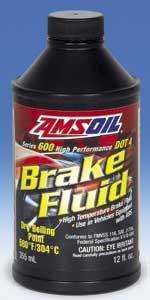
 Series
600 DOT 4 Synthetic Racing Brake Fluid
Series
600 DOT 4 Synthetic Racing Brake Fluid
AMSOIL Brake
Fluids provide superior high-temperature performance
High-temperature performance in
auto/light-truck, high-performance, racing and
powersports applications. High-temperature
stability, yet flows easily at low temperatures.
Helps keep water in suspension, slowing its effects
on the brake system. High boiling temperatures
ensure maximum life and reliable braking power.
See Pricing Information or Place an Order through the AMSOIL
Online Store
Product Code: BF4SN-EA
Package sizes include:
PRODUCT
DESCRIPTION
AMSOIL
Series 500 DOT 3 High-Performance
Synthetic Brake Fluid and AMSOIL
Series 600 DOT 4 Synthetic Racing
Brake Fluid feature pure base stocks
and robust additives that resist
boil-off and the effects of water
contamination more effectively than
conventional brake fluids. AMSOIL
Synthetic Brake Fluids deliver
superior high-temperature
performance in auto/light-truck,
high-performance, racing and
powersports applications.
CONTAMINATION
Water contaminates the brake system
by seeping through microscopic pores
in flexible brake lines and seals
and through the reservoir fill cap
when opened. Once inside, it quickly
works to corrode brake parts, lines
and seals, leading to eventual
system failure. AMSOIL Synthetic
Brake Fluids keep water in
suspension, slowing its corroding
effects. They lubricate and protect
intricate braking components despite
the inevitable water absorption
associated with braking systems,
delivering long-lasting performance.
BOIL-OFF
The extreme pressure and high heat
common to braking can push
conventional brake fluid beyond its
boiling point, causing it to
vaporize, or boil-off. Even more
problematic, water contamination can
drop the boiling point of
conventional fluid below safe
standards, accelerating the rate at
which it boils off. This leads to a
spongy or unresponsive feeling in
the brake pedal. In contrast, the
unique chemistry behind AMSOIL
Synthetic Brake Fluids increase
their boiling point temperatures
well beyond Department of
Transportation (DOT) standards even
when contaminated with 3.7 percent
water (see chart). They maintain a
stable viscosity over a wide
temperature range and flow easily at
the high pressures generated in
today's automotive brake systems to
deliver consistent, safe braking.
AMSOIL Series 600 DOT 4 Synthetic
Racing Brake Fluid features a wet
equilibrium reflux boiling point
(Wet ERBP) nearly 100°F higher than
the DOT minimum, making it ideal for
high-performance cars, motorcycles
and vehicles used for towing.
| |
DOT Minimum
|
AMSOIL
|
DOT3
ERBP*: |
205°C
(401°F)
|
274°C
(525°F)
|
| Wet ERBP**: |
140°C
(284°F)
|
156°C
(313°F)
|
DOT4
ERBP*: |
230°C
(446°F)
|
304°C
(580°F)
|
| Wet ERBP**: |
155°C
(311°F)
|
193°C
(380°F)
|
*Dry equilibrium
reflux boiling point (ERBP)–the
boiling point of new, freshly opened
brake fluid.
**Wet ERBP–the boiling point of
brake fluid having absorbed 3.7
percent water. Only 3.7 percent
water contamination is often
sufficient to reduce a DOT 3 fluid’s
boiling point below the DOT minimum.
|
Typical Technical
Properties
|
|
AMSOIL
Series 500 DOT 3 High
Performance Synthetic
Brake Fluid and AMSOIL
Series 600 DOT 4 Racing
Synthetic Brake Fluid
|
Equilibrium
Reflux Boiling Point
Dry °C (°F)
Wet °C (°F) |
274 (525)
156 (313) |
304 (580)
193 (380) |
Viscosity
-40°C (-40°F), cSt
100°C (212°F), cSt |
1065
2.0 |
1550
2.0 |
|
pH |
9.0 |
7.2 |
POWERSPORTS
The aggressive driving conditions
and sudden stops common to some on-
and off-road motorcycle and ATV
applications can literally boil
conventional brake fluid, leaving
behind a discolored, dirty solution
that can promote deposit formation
and corrosion on braking components.
Worn brake fluid also fails to
deliver adequate protection against
water ingress common to powersports
equipment exposed to the elements.
The synthetic base stocks and
superior additives in AMSOIL
Synthetic Brake Fluids excel in
demanding powersports applications,
providing reliable brake lever and
pedal response, corrosion protection
and longevity as compared to
conventional brake fluids. AMSOIL
Synthetic Brake Fluids are the
product of choice for racing, heavy
hauling or leisure powersports
applications.
APPLICATIONS
Consult the AMSOIL
Online Product Applications Guide
for application information. For
powersports applications, consult
the owner’s manual to determine the
correct DOT classification.