|
Untreated Fuel Leads to Poor Engine Performance
A vehicle demonstrates its best efficiency and engine
performance when it is new. As the engine ages, its
performance suffers from gasoline fuel-generated
deposits that form on the fuel injectors, intake valves
and combustion chamber. Additives are required to
control deposit formation.
Today’s
fuels, however, lack sufficient treatments of either
enough additives or high quality additives. Fuel system
deposits result in the following:
• Lost
fuel economy
• Lost power and poor throttle response
• Failed emission tests
• Poor drivability - surging, hesitation, stalling,
rough idle
• Engine knocking (pinging) and rap
• Difficult starts
Treated Fuel Delivers Maximum Performance
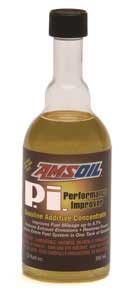
AMSOIL P.i. is the most potent gasoline additive
available today. As a concentrated detergent, it is
unsurpassed in cleaning combustion chamber deposits,
intake valve deposits and port fuel injector deposits.
AMSOIL P.i. helps maintain peak engine efficiency, fuel
economy, power and drivability in newer low mileage
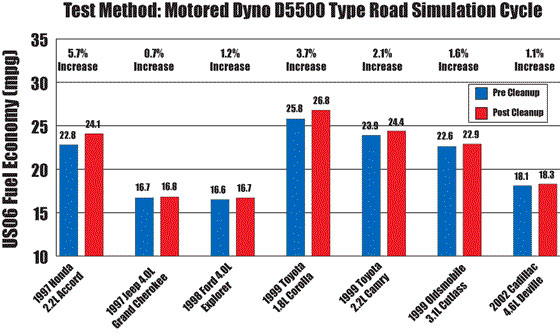
engines. In engines with accumulated deposits, testing
showed AMSOIL P.i. provided the following clean-up
benefits after only one tank of gasoline:
•
Improves fuel mileage an average of 2.3% and up to
5.7%
• Reduced emissions
— hydrocarbons (HC) up to 15%
— carbon monoxide (CO) up to 26%
— nitrous oxides (NOx) up to 17%
• Restored power and performance
• Reduced need for costly higher octane fuel
• Reduced noise from carbon rap and pre-ignition
• Better drivability
• Smoother operation
AMSOIL P.i.
works as an “emissions passer.” It is ideal for use
prior to emissions inspections.
Unsurpassed Deposit Clean-up
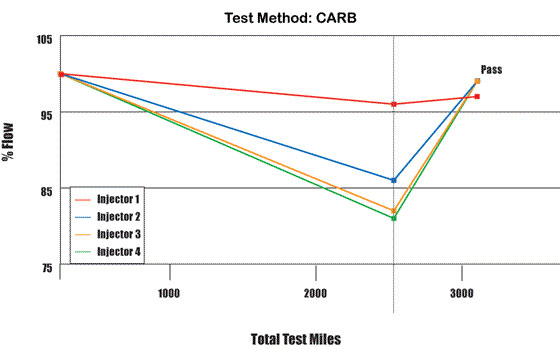
Port Fuel Injector Deposits form after the engine has
been shut down and there is no gasoline flowing through
the injectors. During this “hot soak” period the
injectors heat up and the gasoline remaining in the
injectors degrades and forms deposits. This can happen
very quickly with the use of poor quality gasoline and
short trip driving. Because the clearances within the
injectors are extremely tight and injectors must deliver
precise amounts of “atomized” fuel, even small amounts
of deposits can cause injectors to malfunction. Fuel
flow is reduced and spray patterns are disrupted,
decreasing engine efficiency, power and fuel economy,
while increasing exhaust emissions.
Intake Valve Deposits
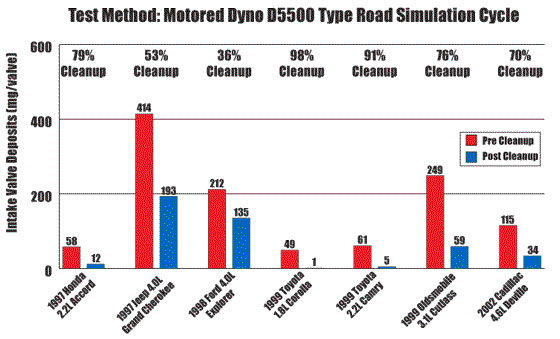
form on the intake side or back side of the valves. As
deposits increase, they restrict airflow and alter
airflow patterns in the cylinder. The deposits disrupt
the balanced air/fuel ratio by momentarily absorbing and
releasing fuel, and they can cause valve sticking by
getting in the way of the valve stem and guide. Deposits
also restrict proper seating, and the valves may be
burned. Intake valve deposits cause lost engine power,
increased emissions, poor engine efficiency and
potential valve failure.
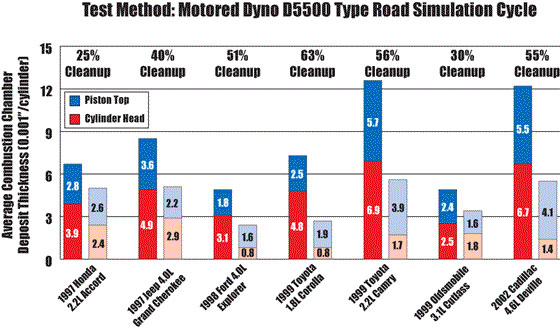
Combustion Chamber Deposits
form on the top of the pistons and on the cylinder
heads. They increase compression and absorb heat during
combustion to later release it during the intake cycle.
In some engines with tight squish domes, combustion
chamber deposits cause the piston to actually hit the
cylinder head. This is referred to as combustion chamber
deposit interference or “carbon rap.” Combustion chamber
deposits also flake off as they get large, and these
flakes can get trapped between the valves and valve
seat, resulting in compression loss, difficult starting
and rough idle.
Higher
compression and stored heat cause increased intake fresh
charge temperatures and the increased likelihood of
pre-ignition “knock” or “pinging” when the fuel
spontaneously combusts prior to spark ignition. This
increases emissions and may cause engine damage. Many of
today’s cars have “knock” sensors that adjust spark
timing to prevent knock.
Although
audible knock is controlled, power is lost from retarded
timing. Higher octane fuels of 4-5 octane numbers can be
used to help prevent knock, an effect called “octane
requirement increase.”As a vehicle ages, more-expensive,
higher-octane fuel is needed to keep it operating at
peak performance. By cleaning combustion chamber
deposits, knock is controlled, power is restored, fuel
economy increases and higher-octane fuels are less
necessary for peak performance.
Maximum Fuel Economy
AMSOIL P.i. maximizes fuel efficiency by dissolving and
removing fuel system deposits and other contaminants for
improved power and overall performance.
Recommendations
Treat one full tank of gas up to 20 gallons with one
bottle of P.i. For very large gas tanks, partially fill
to 40 gallons and treat with two bottles of P.i. Using
more than two bottles per treatment is not recommended.
Treat gas every 4,000 miles of service (or 100 hours for
marine, stationary and off-road gasoline-powered
engines). P.i. helps pass emission tests by running one
tank of treated fuel through the engine prior to
testing. Safe for use with catalytic converters, oxygen
sensors, oxygenated gas and 10 percent ethanol blended
gas. Not recommended for two-cycle engines.
DANGER:
Combustible. Harmful or fatal if swallowed. Harmful if
inhaled. Skin and eye irritant. Read precautions on
container before use. |